
Light reaches your skin.
The panel sends red and near infrared light toward your body. Some of that light passes into the tissue beneath the skin.

Understand the science. Explore the wavelengths.
Find a panel that fits your routine.
Compare 10 panels, explore the science, and see what I learned from personally testing six.
 LUKE BENNETT / BIOHACKER
I’m a biohacker with a practical interest in recovery technology. I’ve personally used six red light therapy panels to explore how they fit into an everyday routine.
I share what I learned from using these panels, explain the science, and compare the features that matter when choosing a device.
Red light therapy has reduced pain in clinical studies. Here’s how light interacts with your body; and what researchers have measured.
The panel sends red and near infrared light toward your body. Some of that light passes into the tissue beneath the skin.
Light interacts with parts of your cells. Scientists study how this affects cell energy and the signals involved in inflammation and pain.
In a controlled study of people with jaw pain, the group treated with red and near infrared LEDs had less pain after treatment. The placebo group did not show that improvement.
Read the clinical study ↗This result applies to the condition and treatment studied; not every type of pain or every home panel.
Explore how light interacts with cells, what pain studies found, and how clinical treatments compare with home panels.
Red light is visible. Near infrared is invisible. Scroll through five wavelengths you’ll see on panel specifications.
660 nm is in the red part of the visible spectrum.
Position follows wavelength. Near infrared colours are illustrative. This is not a tissue depth chart.
This wavelength produces the familiar red glow. It is used in LED research, including studies that combine red and near infrared light.
810 nm is near infrared. Your eyes cannot see it, even when the LED is working. Look at the specifications to know whether a panel includes it.
830 nm sits close to 810 nm; just 20 nanometres apart. Both are near infrared; a different number is not a separate colour you can see.
The jaw pain trial discussed above combined 850 nm near infrared LEDs with 660 nm red LEDs. The study tested that combination, not each wavelength separately.
1064 nm sits farther along the near infrared spectrum. It has been studied in pain related laser treatments. We’ll look at what that means for home panels next.
Why researchers study it. 1064 nm is invisible near infrared light. In laboratory tests on skin and muscle samples, it passed through tissue more effectively than 905 nm, although the difference was small. This makes it relevant to research on delivering light beneath the skin.
Check what your panel includes. Some lower priced options use only 660 and 850 nm. Hooga HG1000, for example, does not include 1064 nm; RLT Home Total Spectrum MAX does. Look at the exact model's wavelength list before buying.
What this means for pain. Clinical studies of powerful 1064 nm lasers have reported pain relief for conditions including knee arthritis and spinal disorders. Home LED panels deliver light differently.
Look beyond the wavelength list. Panels that include 1060 or 1064 nm can allocate different amounts to these wavelengths. Ask how many LEDs are dedicated to each wavelength and how much light they deliver.
RLT Home Total Spectrum MAX: The manufacturer lists 14% density at 1064 nm. PlatinumLED BIOMAX: Its published spectrum article lists 1060 nm as 8% of the NIR array's output.
LED allocation helps explain a panel's design. To assess light delivery beneath the skin, also look for measured output at that wavelength and the recommended treatment distance. A higher LED percentage alone does not establish greater penetration.
Read PlatinumLED's spectrum breakdown ↗
Read the tissue penetration study ↗Specifications: Hooga HG1000 · RLT Home Total Spectrum MAX
Wavelength tells you the type of light. Irradiance tells you how much light power reaches each square centimetre of skin.

Irradiance is light power per unit of area. Together with session time, it determines how much light energy reaches the skin. It helps you compare output more meaningfully than the brightness of the red glow.
I personally tested irradiance with a spectrometer for every panel I used: RLT Home, Helio Cure, PlatinumLED, Joovv, Hooga and Rouge.
Check the distance. A reading taken close to a panel is not the same as one taken farther away.
Compare the same settings. Brightness, active wavelengths, meter calibration and sensor position affect the reading.
Look at the whole session. More intensity is not automatically better. Follow the panel's instructions for distance and session time.
I have personally reviewed and tested six of the ten panels in this guide. Here’s how they compare, alongside four more options researched from manufacturer specifications.
The six panels I tested are from RLT Home, Helio Cure, PlatinumLED, Joovv, Hooga and Rouge. RLT Home is my personal first choice among them.
Ten panels to compare, with six personally used by Luke and four additional options researched from manufacturer specifications.
Our 100 point review framework weighs practical features and ownership. Scores will be assigned after the supporting evidence is complete. The order below is the editorial shortlist, not a calculated score ranking.
Starting prices refer to each brand’s entry model. The full review below covers the named model.
| ORDER / PANEL REVIEWED | CONSIDER IT FOR | RANGE STARTS AT | REVIEW BASIS | SCORE / 100 |
|---|---|---|---|---|
01 RLT HomeTotal Spectrum MAX | Flexible controls and presets | US$495Total Spectrum MINI · sale | Personally used | Score: Not yet scored |
02 PlatinumLEDBIOMAX 600 | A setup you can expand | US$499BIO 450 · BIO series | Personally used | Score: Not yet scored |
03 JoovvSolo 3.0 | A modular system | US$1,099Mini 3.0 | Personally used | Score: Not yet scored |
04 HoogaHG1000 | Simple switches and controls | US$149HG200 · HG series | Personally used | Score: Not yet scored |
05 RougeMax G4 | A tall format with app controls | CA$304Rouge Nano · portable | Personally used | Score: Not yet scored |
06 Helio CureHelio Glow | A supplied floor stand | US$449Helio Spark | Personally used | Score: Not yet scored |
07 Mito Red LightMitoMIN 2.0 | A compact tabletop setup | US$249MitoMIN 2.0 · Original series | Researched | Score: Not yet scored |
08 BestqoolBQ60 | A compact panel with a timer | US$149BQ40 · new unit | Researched | Score: Not yet scored |
09 BlockBlueLightPowerPanel Portable | Portability and limited space | US$299.95PowerPanel Portable · without stand | Researched | Score: Not yet scored |
10 BON CHARGEDemi | A smaller panel with separate modes | US$299Mini · portable device | Researched | Score: Not yet scored |
 Model reviewed
Flexible controls and presets
The MAX brings seven wavelength bands, a touchscreen and a remote into one large panel. Nine presets give you a convenient starting point, while the custom mode leaves room to adjust your session.
A strong option for someone who wants a larger setup with several ways to control it. The 60 day trial is also worth considering alongside the warranty.
The MINI starting price is for a different, smaller model. Compare the actual dimensions and included mounting equipment for the model you choose.
Of the six panels I’ve personally used, RLT Home is my first choice. MAX is the model shown here; explore the range to choose a size that fits your routine.
The score assesses the panel and ownership experience. It is not a clinical pain relief rating.
Choose your model
Total Spectrum MAX is the model reviewed here. The starting price refers to Total Spectrum MINI · sale. Check current stock, included accessories, shipping and return terms for your location.
 Model reviewed
A setup you can expand
BIOMAX 600 combines a tall, narrow shape with digital controls and a linkable design. Its format is worth considering if you want to build a larger setup with compatible panels over time.
Its narrow housing offers a different layout from a wider panel. Compare your available space and mounting position before deciding which size to buy.
The starting price belongs to the separate BIO series. Check the exact BIOMAX generation, wavelength list and mounting accessories in the listing you order.
BIOMAX 600 is one of the six panels I’ve personally used. Compare model sizes and mounting options alongside your budget.
The score assesses the panel and ownership experience. It is not a clinical pain relief rating.
Choose your model
BIOMAX 600 is the model reviewed here. The starting price refers to BIO 450 · BIO series. Check current stock, included accessories, shipping and return terms for your location.
 Model reviewed
A modular system
Solo 3.0 is built around an expandable system of compatible Joovv panels. It is a useful option to compare when you want your initial purchase to form part of a larger arrangement later.
The system approach is its main point of difference here. Plan the eventual arrangement as well as the first panel so you can account for mounting space.
Check which mounting accessories are included and which compatible components you would need to expand. The starting price shown is for Mini 3.0.
Solo 3.0 is one of the six panels I’ve personally used. For this option, consider the complete setup you want rather than choosing on the starting price alone.
The score assesses the panel and ownership experience. It is not a clinical pain relief rating.
Choose your model
Solo 3.0 is the model reviewed here. The starting price refers to Mini 3.0. Check current stock, included accessories, shipping and return terms for your location.
 Model reviewed
Simple switches and controls
HG1000 uses 660 nm red light and 850 nm near infrared light, with separate switches for the two light types. This gives it a simpler control approach than the touchscreen models in this comparison.
It is worth considering if you prefer a straightforward panel and do not need a menu of presets. Its tall shape also deserves a space check before purchase.
It has two wavelength bands. Decide whether you actually want extra modes and controls before paying for a more complex model. The entry price is for HG200.
HG1000 is one of the six panels I’ve personally used. Compare its simple controls with the features you expect to use regularly.
The score assesses the panel and ownership experience. It is not a clinical pain relief rating.
Choose your model
HG1000 is the model reviewed here. The starting price refers to HG200 · HG series. Check current stock, included accessories, shipping and return terms for your location.
 Model reviewed
A tall format with app controls
Max G4 offers eight wavelength bands and touchscreen, remote and app controls. Its tall format makes it a different proposition from the compact tabletop models listed below.
The multiple control options are useful to compare if you want flexibility in how you start and adjust a session. Check the space needed for the complete setup.
This listing uses Canadian dollars. The starting price refers to the portable Nano, while the reviewed Max G4 listing is a bundle. Compare currencies and bundle contents carefully.
Max G4 is one of the six panels I’ve personally used. Check the exact bundle and the room available for a tall panel before choosing.
The score assesses the panel and ownership experience. It is not a clinical pain relief rating.
Choose your model
Max G4 is the model reviewed here. The starting price refers to Rouge Nano · portable. Check current stock, included accessories, shipping and return terms for your location.
 Model reviewed
A supplied floor stand
Helio Glow combines six wavelength bands with a touchscreen and remote. The listed floor stand gives it a practical point of difference for someone considering a freestanding setup.
A supplied stand can simplify planning your purchase. Compare the stand position and the space around the panel with where you intend to use it.
Confirm the stand is included in your selected listing and region. The lower starting price refers to Helio Spark, not the Helio Glow shown here.
Helio Glow is one of the six panels I’ve personally used. Compare what comes in the box as well as the panel itself.
The score assesses the panel and ownership experience. It is not a clinical pain relief rating.
Choose your model
Helio Glow is the model reviewed here. The starting price refers to Helio Spark. Check current stock, included accessories, shipping and return terms for your location.
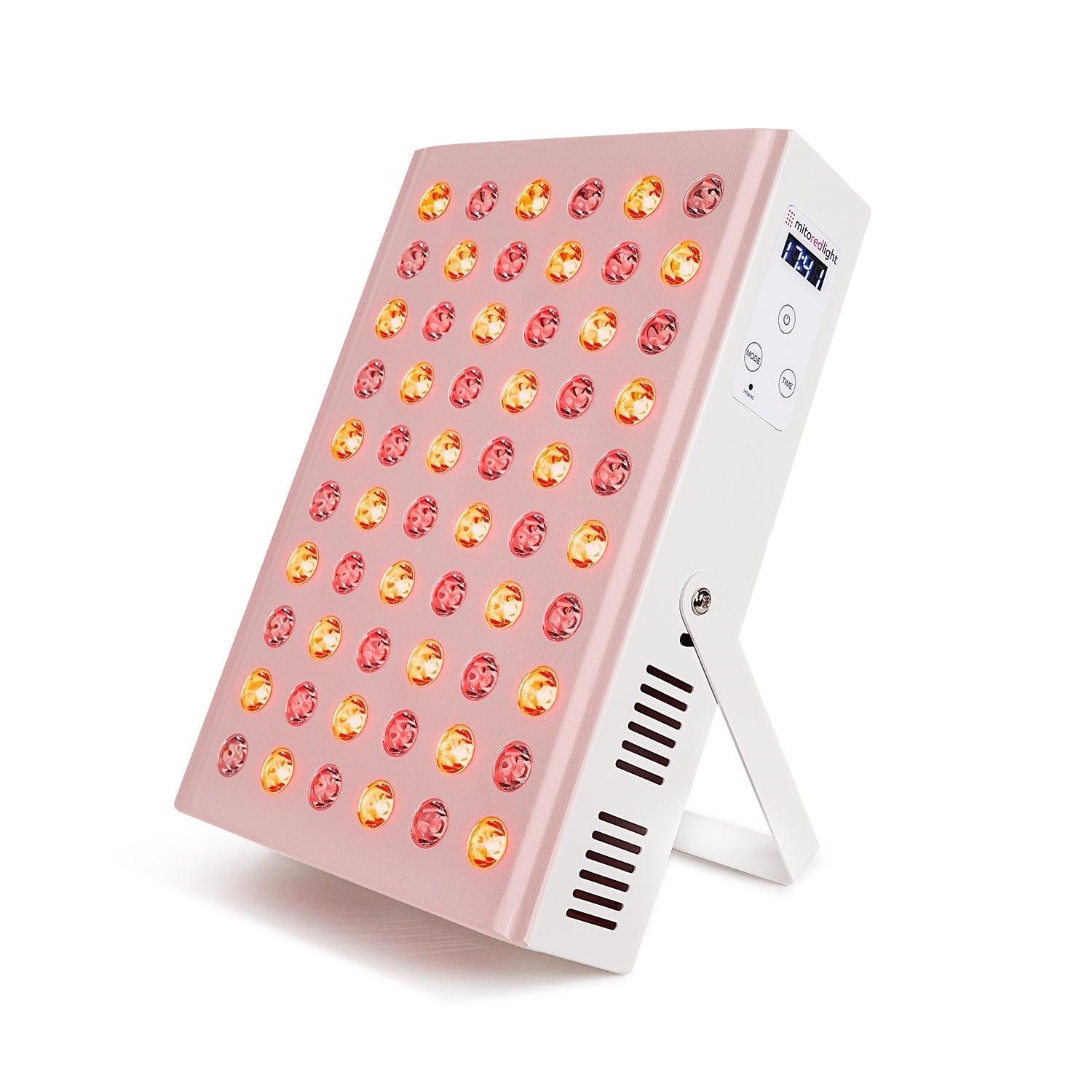 Model reviewed
A compact tabletop setup
MitoMIN 2.0 is a compact panel with a kickstand and an adjustable session timer. It uses 660 nm and 850 nm light and takes a different approach from the tall panels above.
Consider it for a smaller space where a tabletop arrangement makes more sense. Its size is central to the buying decision, rather than a long list of controls.
A compact panel covers a smaller area at a given position than a larger panel. Think about how much repositioning your intended routine would require.
This model is included from product research. Luke has not personally used it, so this review does not include a personal testing verdict.
The score assesses the panel and ownership experience. It is not a clinical pain relief rating.
Choose your model
MitoMIN 2.0 is the model reviewed here. The starting price refers to MitoMIN 2.0 · Original series. Check current stock, included accessories, shipping and return terms for your location.
 Model reviewed
A compact panel with a timer
BQ60 combines two wavelength bands, a digital timer and an adjustable stand. Its compact housing is suited to comparing smaller setups rather than matching it directly against a tall panel.
The timer and adjustable stand are practical features to examine together. Check whether the available angle works with your table height and intended position.
The starting price is for BQ40. Check the size difference between BQ40 and BQ60 before choosing the lower priced option.
This model is included from product research. Luke has not personally used it, so the observations here concern listed features and buying considerations.
The score assesses the panel and ownership experience. It is not a clinical pain relief rating.
Choose your model
BQ60 is the model reviewed here. The starting price refers to BQ40 · new unit. Check current stock, included accessories, shipping and return terms for your location.
 Model reviewed
Portability and limited space
PowerPanel Portable measures 150 × 140 × 35 mm and offers 10, 15 or 20 minute timer settings. Its small format is the main reason to include it in this comparison.
It is worth comparing for travel or a compact home arrangement. Consider how you will position a small device as well as where you will store it.
The starting listing excludes a stand. Include any positioning accessory you need when comparing the total cost.
This model is included from product research. Luke has not personally used it. Portability should be weighed against the smaller treatment area.
The score assesses the panel and ownership experience. It is not a clinical pain relief rating.
Choose your model
PowerPanel Portable is the model reviewed here. The starting price refers to PowerPanel Portable · without stand. Check current stock, included accessories, shipping and return terms for your location.
 Model reviewed
A smaller panel with separate modes
Demi offers separate red and near infrared modes with a built in timer. Its 38 × 22 × 6.5 cm housing gives you a concrete size to compare with a tabletop or wall setup.
Consider the combination of simpler controls and a smaller housing if you do not need the tallest format. Measure the position where you plan to use it.
The starting price refers to the portable Mini. Demi is a separate model, and the listed warranty is one year. Check current terms for your region.
This model is included from product research. Luke has not personally used it, so no personal measurement or treatment outcome is claimed.
The score assesses the panel and ownership experience. It is not a clinical pain relief rating.
Choose your model
Demi is the model reviewed here. The starting price refers to Mini · portable device. Check current stock, included accessories, shipping and return terms for your location.
Some studies report benefits for particular conditions and protocols, but results and evidence quality vary. These findings do not guarantee results from the panels listed here. See the science section for sources and limitations.
The research cited here does not establish that 1064 nm is necessary or that a home panel containing it is superior for pain relief. Evaluate the whole device and its supporting evidence.
Follow the instructions for your exact device, including distance, exposure, and eye precautions. There is no single schedule on this page that applies to every panel or medical condition.
No. Luke reports personally using RLT Home, Helio Cure, PlatinumLED, Joovv, Hooga and Rouge. Mito Red Light, Bestqool, BlockBlueLight and BON CHARGE are research based additions, using manufacturer specifications.
Discuss suitability with a qualified healthcare professional. This guide provides product information and does not diagnose a condition, replace treatment, or promise pain relief.