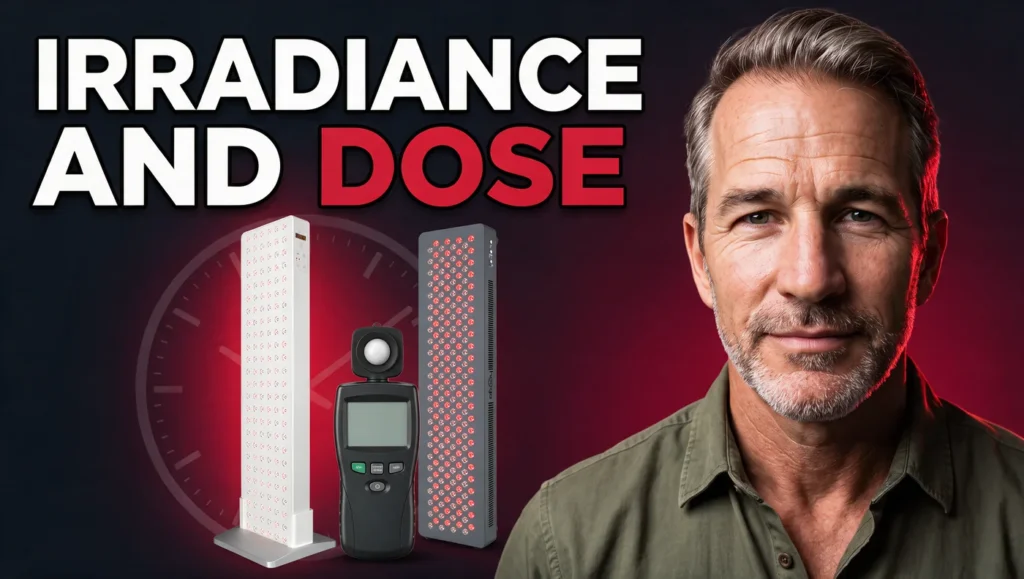


There is no single best distance or session length for every red light therapy panel. Use the instructions for the specific device and intended use, keep the setup repeatable and avoid increasing exposure simply because a session feels mild. Distance, angle, wavelength mode and time all change the light delivered, while eye and skin safety require attention of their own.
Start with the device instructions
A useful manual should make the intended use understandable. Look for the operating modes, the recommended position, session limits, eye precautions and any situations in which the device should not be used. If instructions are missing or contradictory, ask the manufacturer to resolve the uncertainty before improvising a routine.
A preset timer does not explain the entire treatment. It tells you when the device stops under a particular setting. It may not explain the correct distance for your use, whether multiple areas can be treated in succession or how the setting relates to the clinical evidence.
The FDA’s 2023 draft guidance for photobiomodulation devices discusses labeling, user understanding, thermal safety and eye safety. It is a draft with nonbinding recommendations, not a universal consumer protocol. Its relevance here is the recognition that safe use depends on device design and comprehensible instructions, as well as optical output. Read the FDA draft guidance.
Our panel guide can help compare practical features, but a buying article should not be used as a replacement manual. Check the exact model and version of the instructions supplied with it.
Make distance and positioning repeatable
Distance matters because it changes the geometry of illumination. As a body region moves relative to an array of emitters, the light reaching it can become more or less intense and more or less even. Moving closer is not automatically an improvement.
First identify what the manufacturer means by distance. Is it measured from the emitter surface, the front housing or another reference? Then use the same reference each time. A simple marked position for a chair or stand can be more useful than remembering roughly where you sat.
Keep the body area and angle consistent too. A knee facing the panel directly is not in the same setup as a knee turned partly away. Choose a comfortable position that does not require holding an awkward posture for the full session. The stand or mounting arrangement should allow that position without unstable balancing.
A primary study of human light transmission found that tissue characteristics and equipment influenced how 660 nm and 830 nm light passed through the tested regions. This reinforces a limit: a repeatable external setup does not guarantee a known exposure inside every person’s tissue. Read the human tissue transmission study.
For a deeper explanation of surface measurements, see irradiance and dose. It explains why a measured surface value is useful without pretending it is a direct measurement inside a joint.
Keep time and frequency in context
Session time becomes meaningful when the device, mode, distance and area are specified. Advice to use red light for a fixed number of minutes without those details is incomplete. A timer alone cannot make two different products equivalent.
Published treatment schedules also vary. For example, a knee osteoarthritis trial applied clinical laser treatment three times weekly for three weeks alongside a longer strength program. That schedule describes the trial. It is not a recommendation for using a broad home panel at the same frequency. Read the clinical trial protocol and findings.
Keep to the schedule appropriate for the device and your situation. If a session is missed, do not assume that doubling the next exposure restores the intended routine. A longer exposure changes a variable, and the biological effect cannot be inferred solely by adding minutes.
Changing several settings at once makes it difficult to understand what happened. If the instructions allow a choice of settings, record what you used. A consistent routine is easier to evaluate than a series of sessions with changing distances, times and modes.
That consistency is a measurement habit, not a promise that benefits accumulate indefinitely. Our joint pain evidence article explains why a repeatable protocol still needs evidence that it produces a meaningful result.
Understand eye exposure and heat
Do not stare into the emitters to judge whether they are working. Follow the model’s eye protection instructions, including requirements related to the wavelengths being used. If protective eyewear is specified, confirm that it is appropriate for the device rather than assuming ordinary tinted glasses provide the same protection.
The FDA draft explicitly considers the potential for ocular tissue damage and harmful temperature increases in photobiomodulation device assessment. A product’s description as low level light does not remove the need to evaluate those hazards. See the eye and thermal safety sections.
Heat sensation is not a dose meter. Comfortable warmth does not prove a therapeutic effect, and uncomfortable heating is not a reason to push through a session. Stop if the exposure causes burning discomfort or an unexpected skin response, and obtain advice before resuming.
A laboratory pilot study of handheld home LED products recorded heating in tissue samples under tested conditions. Those measurements cannot be used to predict the temperature from every panel, but they show why LED illumination should not automatically be described as incapable of heating tissue. Read the laboratory pilot study.
Protect the setup as well as the body. Keep ventilation clear as instructed, inspect the equipment for visible damage and use a stable support. Position the timer and controls so you can stop the device without reaching across hot surfaces or disturbing the stand.
Check relevant personal factors
Read the model’s warnings in relation to your health and medications. If you have a condition that changes sensitivity to light, take a medicine with a light sensitivity warning or are uncertain about a treated area, ask a clinician or pharmacist whether the specific device is suitable. Bring the wavelength and use instructions to that conversation.
Pregnancy, cancer treatment, an unexplained lesion, impaired sensation or an existing eye condition can require individual advice. Do not infer suitability from a general online statement about red light. The fact that a device was tolerated in a selected study population does not establish suitability for people who were excluded from that study.
These are reasons to check the actual situation rather than create a universal list of forbidden conditions. A clinician using a particular light treatment for a defined medical indication is making a different decision from someone experimenting with a general wellness panel at home.
For the underlying biology, the science overview and cellular mechanisms article explain why the type of tissue and exposure matter. Neither provides personalized clearance to use a device.
Use a simple session record
A brief record can make a routine easier to assess. It should capture the setup and an outcome you care about, rather than creating a large collection of numbers that are difficult to interpret. The following is a suggested record format, not a validated clinical assessment.
| Field | What to record |
|---|---|
| Device and mode | Model, wavelength selection and intensity setting |
| Position | Body area, posture and distance reference |
| Exposure | Session duration and any interruption |
| Comfort | Unexpected warmth, skin response or other discomfort |
| Relevant outcome | A consistent symptom or daily activity observation |
| Other changes | Exercise, medication changes or unusual activity that may affect symptoms |
Pick a practical outcome before starting the record. For example, you might note discomfort during an ordinary activity that is already appropriate for you. Do not repeatedly provoke pain just to test whether the device has worked.
Review patterns over time without claiming that every change was caused by light. A record can show what happened alongside use. It cannot provide the same causal information as a controlled trial.
Know when to stop and reassess
Stop a session if you develop an unexpected adverse response. New visual symptoms, a burn or persistent irritation deserve medical advice. Equipment damage or irregular operation should be resolved before further use.
For joint pain, a hot swollen joint or symptoms accompanied by fever or feeling unwell warrant urgent assessment. Severe pain or inability to bear weight after an injury also requires prompt care. A panel routine should never delay that assessment. Read the NHS advice on urgent joint symptoms.
If symptoms are not improving, do not treat a longer session as the automatic next step. Revisit the diagnosis, instructions and expectations with an appropriate clinician. A useful routine has a reason to continue and a sensible point at which to reassess its value.
Common questions
Is there a universal best distance?
No. It depends on the panel and intended use. Use the model’s instructions and measurements at the relevant distance rather than copying a distance from an unrelated product or study.
Are closed eyes enough protection?
Do not assume so. Follow the device’s eye safety instructions and ask for clarification if they are unclear. Invisible near infrared light cannot be judged by how bright it appears.
Should I increase the time if I feel nothing?
No. Sensation is not a reliable measure of the biological response or the exposure. Keep to the instructions and assess outcomes without escalating simply to produce a stronger feeling.